🌱 How to Improve Soil Fertility Through Integrated Soil Management
Soil is the functional base of agricultural productivity—its physical, chemical, and biological health directly governs crop yield and resilience. The following evidence-based practices sustainably enhance soil fertility:
Soil as a Dynamic System
Soil is not an inert medium; it is a living, dynamic system where minerals, organic matter, water, air, and biota interact continuously. Fertility depends on:
- Physical properties: structure, texture, porosity, bulk density
- Chemical properties: pH, nutrient availability, cation exchange capacity (CEC)
- Biological properties: microbial activity, organic matter turnover
Sustainable fertility management requires simultaneous optimization of all three domains.
Test your knowledge
[Explore all MCQs]
[Soil Science MCQs] [Soil Physical Properties MCQs] [Soil Chemical Properties MCQs [Crop and Environment MCQs][Fundamentals of Plant Nutrition MCQs]
[Botany MCQs ] [Plant Physiology MCQs][Environmental Science MCQs]
2. Organic Matter: The Central Driver
Organic matter is the cornerstone of soil fertility. Its addition through compost, farmyard manure, or green manure leads to:
- Improved soil aggregation and structure
- Increased water-holding capacity
- Enhanced CEC and nutrient retention
- Stimulation of microbial activity
Organic matter acts as both a nutrient reservoir and a regulator of soil processes.
How to Improve Soil Fertility Through Integrated Soil Management, Soil fertility improvement, Sustainable agriculture practices, Soil health management, Integrated nutrient management, Climate-Smart Agriculture Management
3. Crop Rotation and Nitrogen Cycling
Crop rotation, particularly with legumes, introduces biological nitrogen fixation into the system. This process:
- Converts atmospheric nitrogen (N₂) into plant-available forms
- Reduces dependency on synthetic fertilizers
- Breaks pest and disease cycles
- Improves soil structure through diverse root systems
This ecological intensification improves both productivity and sustainability.
4. Cover Crops and Soil Protection
Cover crops play a critical role in maintaining soil integrity during fallow periods. Their benefits include:
- Reduction of erosion and nutrient loss
- Enhancement of soil organic carbon
- Improvement in nutrient cycling efficiency
- Suppression of weeds and stabilization of soil temperature
They serve as a biological shield for soil ecosystems.
How to Improve Soil Fertility Through Integrated Soil Management, Soil fertility improvement, Sustainable agriculture practices, Soil health management, Integrated nutrient management, Climate-Smart Agriculture Management
5. Balanced Nutrient Management
Soil fertility is not merely about adding nutrients but optimizing their balance. Key considerations include:
- Macronutrients: N, P, K
- Secondary nutrients: Ca, Mg, S
- Micronutrients: Zn, Fe, B, Mn, Cu
Soil testing enables precise nutrient application, preventing both deficiencies and toxicities while improving nutrient use efficiency.
6. Soil pH: The Master Variable
Soil pH regulates nutrient solubility, microbial activity, and overall soil chemistry.
- Acidic soils may lead to Al toxicity and nutrient deficiencies
- Alkaline soils often limit micronutrient availability
Maintaining pH within the optimal range (≈6.0–7.5) ensures maximum nutrient accessibility and biological activity.
7. Soil Physical Integrity and Tillage
Excessive tillage disrupts soil structure, accelerates organic matter loss, and reduces microbial habitat. Conservation practices such as minimum or no-tillage:
- Preserve soil aggregates
- Enhance carbon sequestration
- Improve water infiltration and retention
- Support soil biodiversity
This approach aligns with climate-smart agriculture principles.
8. Chemical Inputs and Soil Biology
While fertilizers and pesticides are important tools, excessive use can:
- Disrupt microbial communities
- Reduce soil enzymatic activity
- Lead to nutrient imbalances
Integrating biofertilizers and IPM strategies maintains ecological balance while sustaining productivity.
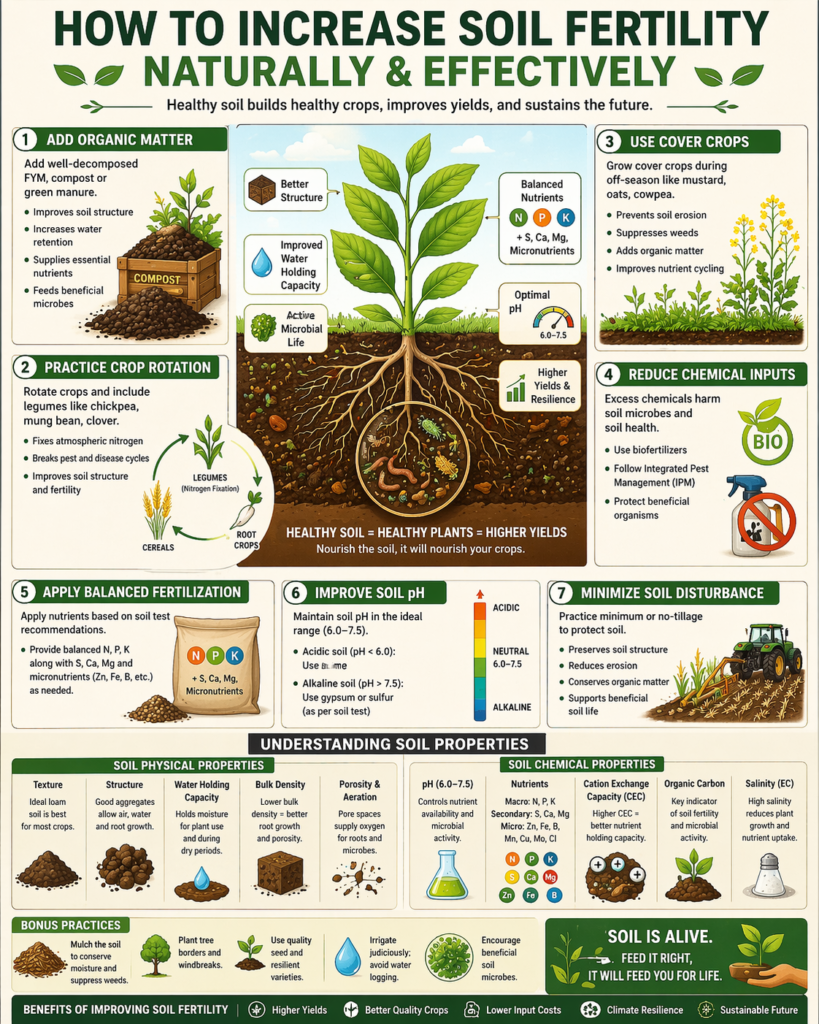
Integrating Soil Physical and Chemical Properties
The infographic effectively highlights that:
- Soil texture and structure influence water and nutrient dynamics
- CEC links soil chemistry with fertility potential
- Organic carbon is a key indicator of soil health
- Salinity and pH regulate nutrient availability and plant growth
Thus, soil fertility management must be integrative rather than input-driven.
Enhancing soil fertility is not a single intervention but a coordinated strategy that integrates organic inputs, crop diversity, nutrient management, and conservation practices. By improving soil physical structure, optimizing chemical balance, and sustaining biological activity, we can build resilient agroecosystems capable of supporting high productivity under changing environmental conditions.
Healthy soil is a self-regulating system—when managed holistically, it sustains both crop yields and ecosystem services.
How to Improve Soil Fertility Through Integrated Soil Management, Soil fertility improvement, Sustainable agriculture practices, Soil health management, Integrated nutrient management, Climate-Smart Agriculture Management
#SoilFertility #SustainableAgriculture #SoilHealth #ClimateSmartAgriculture #OrganicFarming
[Explore all MCQs]
[Soil Science MCQs] [Soil Physical Properties MCQs] [Soil Chemical Properties MCQs [Crop and Environment MCQs][Fundamentals of Plant Nutrition MCQs]
[Botany MCQs ] [Plant Physiology MCQs][Environmental Science MCQs]