
Principles of Conservation Tillage in Alleviating Soil Compaction
Soil compaction is a major form of soil physical degradation characterized by increased bulk density, reduced porosity, and restricted root penetration. It disrupts water movement, gas exchange, and biological activity, ultimately limiting crop productivity. Compaction commonly arises from heavy machinery traffic, repeated tillage at fixed depths (leading to plow pan formation), rainfall impact on bare soil, and livestock trampling.
Conservation tillage (CT), including no-till and reduced tillage systems, offers a sustainable alternative by shifting soil management from mechanical disturbance to biological and structural restoration processes.
Conventional Tillage
Conventional tillage involves intensive mechanical soil disturbance using implements such as moldboard plows, disk harrows, and cultivators to create a fine seedbed and control weeds. Typically, it includes multiple field passes and substantial soil inversion, leaving limited surface residue cover. While effective for short-term seedbed preparation, conventional tillage exerts profound and often deleterious effects on soil physical structure and compaction dynamics.
Test Your Knowledge
Conceptualizing Soil Compaction
Compaction should be understood as a structural failure of the soil pore system, rather than merely an increase in bulk density. The reduction in macroporosity and pore connectivity leads to:
- Impaired infiltration and increased runoff
- Restricted root elongation due to high penetration resistance
- Reduced oxygen diffusion and development of anaerobic microsites
- Decline in soil biological activity
Conventional tillage often provides short-term loosening but accelerates long-term degradation by destroying aggregates and promoting subsoil compaction.
Conservation Tillage: Definition and Systems
Conservation tillage refers to a group of practices that minimize soil disturbance and maintain ≥30% surface residue cover after planting. Major systems include:
- No-till (direct seeding)
- Reduced tillage
- Strip tillage
- Mulch tillage
In contrast, conventional tillage involves intensive inversion, multiple machinery passes, and residue burial, which collectively degrade soil structure.
Core Principles of Conservation Tillage
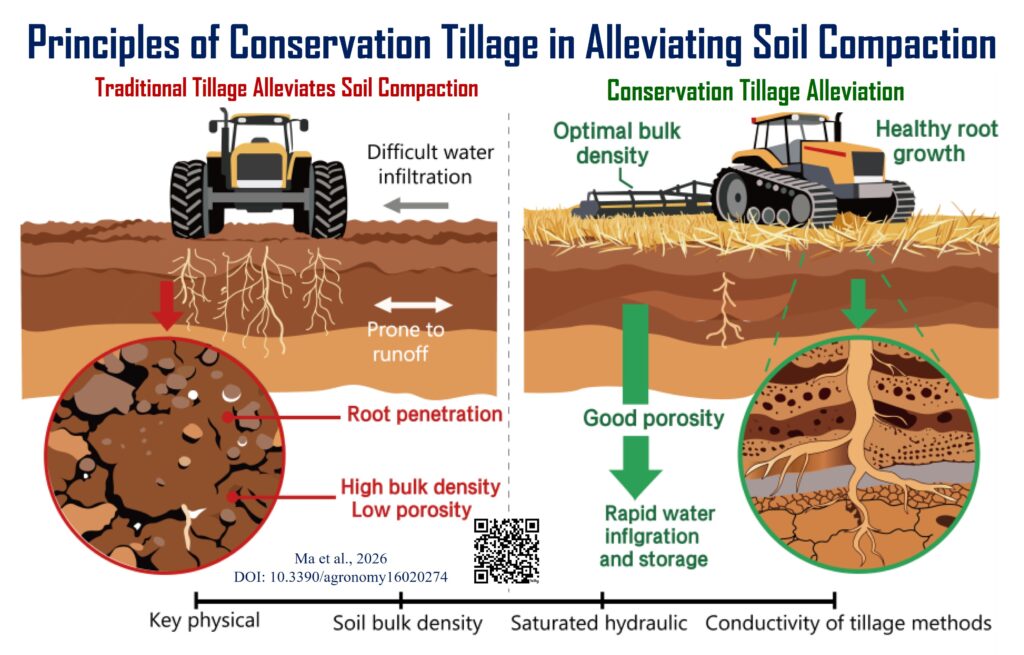
Principles of Conservation Tillage in Alleviating Soil Compaction (Source: Ma et al., 2026)
Minimal Soil Disturbance
Limiting mechanical disturbance preserves aggregate integrity and pore continuity. Reduced tillage prevents the formation of compacted subsurface layers and lowers susceptibility to reconsolidation.
Permanent Soil Cover
Crop residues act as a protective layer that:
- Dissipates raindrop energy
- Reduces surface sealing and crusting
- Buffers soil against traffic-induced compaction
- Enhances moisture regulation and biological activity
Crop Diversification and Biological Structuring
Diverse cropping systems, especially those including deep-rooted species, promote biological tillage (biotillage). Roots and soil fauna generate biopores, while microbial exudates stabilize aggregates.
Soil Organic Matter Restoration
Increased organic matter under CT enhances aggregate stability, improves elasticity, and increases resistance to compressive forces. This is central to long-term compaction resilience.
Controlled Traffic Farming
Restricting machinery movement to fixed lanes localizes compaction, preserving large portions of the soil in an uncompacted and biologically active state.
Mechanistic Pathways of Compaction Alleviation
Conservation tillage alleviates compaction through interconnected processes:
- Aggregate stabilization: Reduced disturbance and organic inputs promote stable macroaggregates
- Biopore formation: Root channels and earthworm activity restore vertical connectivity
- Reduced soil strength: Improved structure lowers penetration resistance
- Enhanced hydraulic function: Increased infiltration reduces runoff and surface sealing
These mechanisms collectively shift soil behavior from mechanically dominated to biologically regulated.
Temporal Dynamics of Structural Recovery
Unlike conventional tillage, which provides transient relief, CT promotes gradual and cumulative improvements:
- Short-term: Slight increase in bulk density due to absence of loosening
- Medium-term (2–5 years): Increased biological activity and pore formation
- Long-term (>5 years): Improved aggregation, porosity, and hydraulic conductivity
This transition reflects the re-establishment of self-organizing soil processes.
Role of Cover Crops
Cover crops are critical in accelerating compaction alleviation:
- Taproots penetrate compacted layers (bio-drilling effect)
- Fibrous roots enhance aggregation
- Residues contribute to soil organic matter pools
Their integration with CT creates strong synergies in restoring soil structure.
Constraints and Context Dependency
The effectiveness of conservation tillage depends on:
- Soil texture (slower response in clay soils)
- Soil moisture (greater risk of compaction under wet conditions)
- Machinery load and traffic intensity
- Management practices (residue handling, crop diversity)
In severely compacted soils, an initial strategic subsoiling may be required before transitioning to CT.
Practical Implementation Strategies
Successful adoption of CT requires system-level management:
- Controlled traffic farming
- Continuous cover cropping
- Use of low ground-pressure machinery
- Avoidance of field operations under wet conditions
- Gradual transition to allow biological recovery
Limitations and Trade-offs
Potential challenges include:
- Temporary surface compaction during transition
- Increased weed management complexity
- Poor performance in poorly drained soils without complementary practices
However, these are typically transitional and outweighed by long-term benefits.
Conceptual Synthesis
Drivers → Processes → Outcomes
- Drivers: Reduced disturbance, residue retention, biological inputs
- Processes: Aggregation, biopore formation, and Soil Organic Matter (SOM) accumulation
- Outcomes: Reduced bulk density, improved porosity, enhanced root growth
Conservation tillage alleviates soil compaction not through repeated mechanical disruption but through progressive biological and structural restoration. By integrating minimal disturbance, residue retention, and enhanced biological activity, CT transforms soil into a resilient, self-regulating system. This paradigm shift—from mechanical intervention to ecological management—is fundamental for sustainable agriculture under increasing environmental pressures.
Suggest Readings
Ma, Y., Y. Zhu, J. Li, Z. Li, D. Zhao, Z. Qu, X. Zhou, W. Zhao, X. Wei, J. Sun, L. Yang, S. Dong. 2026. Addressing Black Soil Compaction: An Integrated Analysis of the Mechanisms, Efficacy, and Future Directions of Conservation Tillage. Agronomy 16: 274. https://www.mdpi.com/2073-4395/16/2/274
Solís-Ramos, L.Y., C. Coto-López, A. Andrade-Torres. 2021. Role of arbuscular mycorrhizal symbiosis in remediation of anthropogenic soil pollution. Symbiosis. 84: 321-336.
Hamza, M.A., W.K. Anderson. 2005. Soil compaction in cropping systems: A review of the nature, causes and possible solutions. Soil and Tillage Research 82: 121-145.
Principles of Conservation Tillage in Alleviating Soil Compaction, conservation tillage practices for sustainable crop production, carbon sequestration under conservation tillage, how conservation tillage alleviates soil compaction in agricultural soils, soil–plant–atmosphere interactions in reduced tillage systems
#ConservationTillage, #SoilCompaction, #SoilStructure, #SoilAggregation, #SoilHealth, #SoilScience, #SustainableAgriculture, #Agroecology, #RegenerativeAgriculture, #SoilManagement
#Biotillage, #SoilOrganicMatter, #AggregateStability, #SoilPorosity, #BulkDensity, #HydraulicConductivity, #SoilCarbon, #RhizosphereProcesses, #MicrobialExudates, #RootSoilInteractions
#PoreConnectivity, #SoilPhysicalProperties, #SoilDegradation, #SoilRestoration, #SoilResilience, #CarbonSequestration, #SoilBiology, #EarthwormActivity, #SoilMicrobiology, #PlantSoilInteractions
#ConventionalTillage, #TillageSystems, #SoilErosion, #LandDegradation, #SoilConservation, #CompactionManagement, #SoilImprovement, #AgriSustainability
Principles of Conservation Tillage in Alleviating Soil Compaction, conservation tillage practices for sustainable crop production, carbon sequestration under conservation tillage, how conservation tillage alleviates soil compaction in agricultural soils, soil–plant–atmosphere interactions in reduced tillage systems