
Soil Compaction: Causes, Mechanisms, and Agronomic Consequences
Soil compaction is a major form of physical soil degradation in agricultural systems, characterized by an increase in soil bulk density and a reduction in pore space. This structural alteration restricts the movement of air, water, and roots, thereby impairing essential soil functions. Compaction commonly develops in surface and subsurface layers, including the formation of dense plow pans that act as barriers to root penetration.
Test Your Knowledge
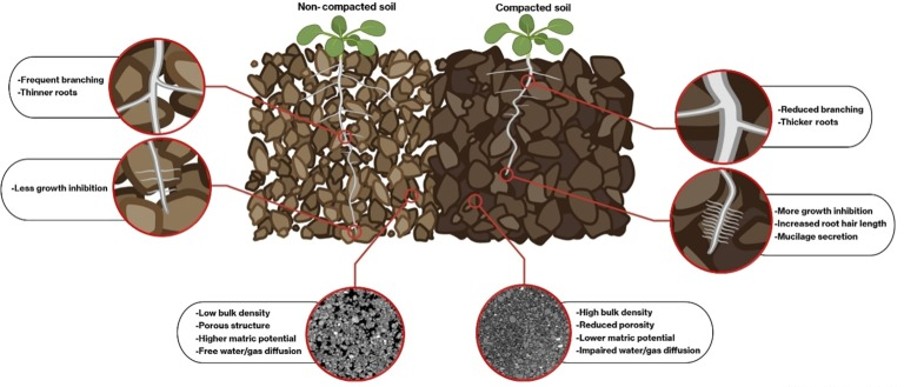
Soil compaction modulates root system architecture (Source: Peralta Ogorek et al., 2025)
Causes of Soil Compaction Soil compaction primarily results from external mechanical forces exceeding the soil’s bearing capacity. Key drivers include:
- Heavy machinery and traffic intensity: Repeated passes of tractors and implements compress soil particles, particularly under high axle loads.
- Tillage under wet conditions: Moist soils are more susceptible to deformation, leading to severe compaction when cultivated.
- Inappropriate tillage practices: Excessive or shallow tillage can create compacted subsurface layers.
- Livestock trampling: Grazing pressure contributes to surface sealing and subsurface densification.
- Low organic matter content: Reduced aggregation weakens soil structure, making it more vulnerable to compaction.
How do plant roots sense soil compaction?
Plant roots sense soil compaction not primarily as a mechanical “push” but as a change in the soil’s gas environment, especially through the accumulation of the gaseous hormone ethylene around the root tip. In compacted soil, a reduced volume of air‑filled pores restricts diffusion, so ethylene builds up in and around root tissues and triggers downstream hormone pathways that reshape root growth.
How roots sense compaction
- Ethylene as a compaction signal: When soil becomes compacted, ethylene—normally able to diffuse out of roots into aerated soil—becomes trapped because air‑filled pores shrink. This local accumulation activates ethylene‑responsive signaling circuits in cells of the root elongation zone.
- Indirect sensing of mechanical impedance: Rather than relying on a dedicated “pressure sensor,” roots effectively use restricted gas diffusion as a proxy for soil strength and compaction status. Knocking out or reducing ethylene sensitivity allows roots to grow more into compacted layers, confirming that ethylene‑mediated inhibition is central to the response.
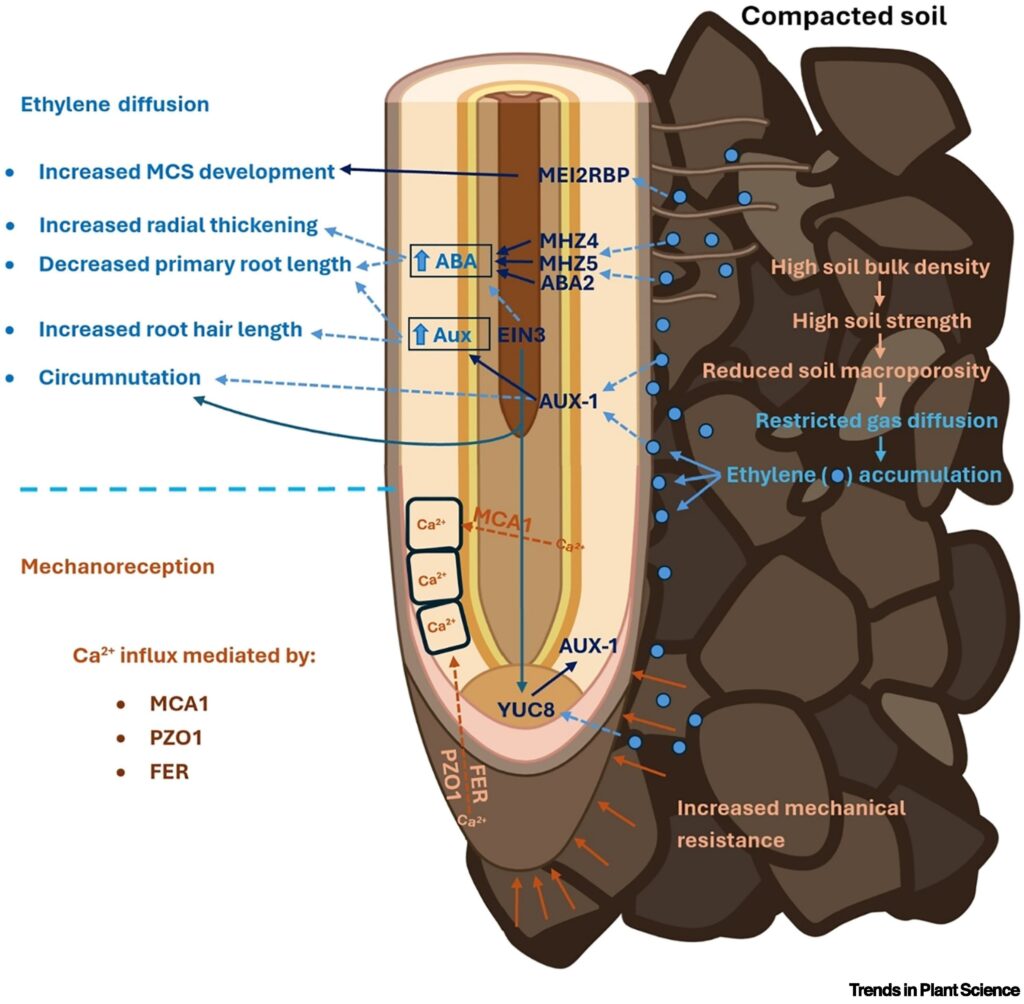
How plant roots sense and respond to soil compaction (Source: Peralta Ogorek et al., 2025)
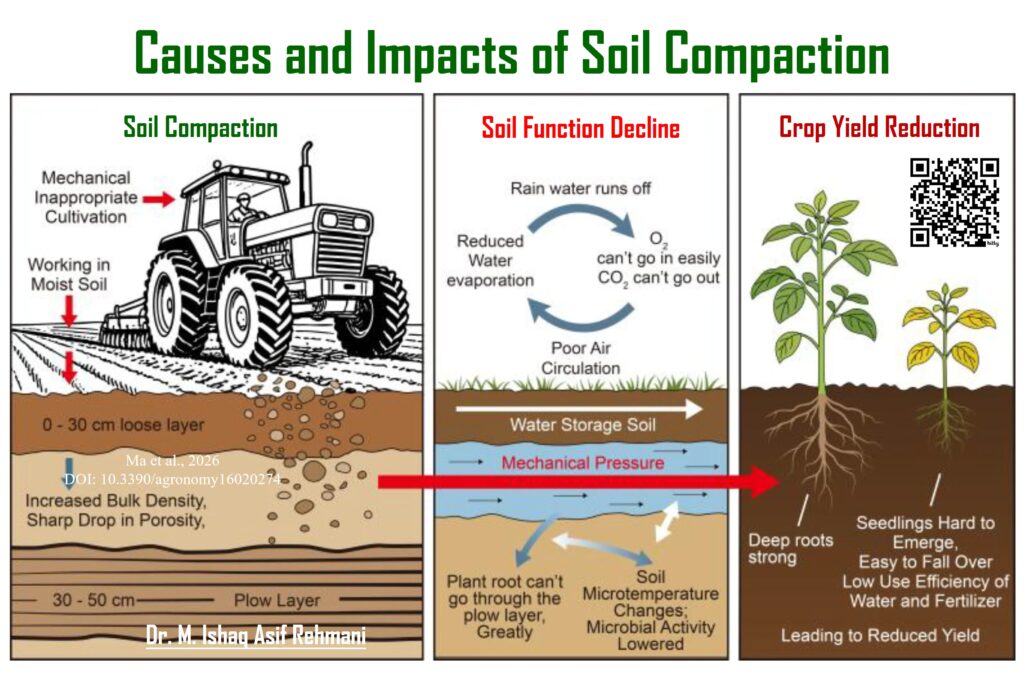
Source: Ma et al., 2026
Physical and Biological Mechanisms
Compaction reduces macroporosity, which disrupts soil aeration and hydraulic conductivity. Oxygen diffusion into the soil declines, while carbon dioxide accumulates, creating hypoxic conditions that limit root respiration and microbial activity. Water infiltration decreases, increasing surface runoff and reducing effective soil water storage. At the same time, pore continuity is lost, hindering root elongation and exploration.
Biologically, compaction suppresses microbial processes, including decomposition and nutrient cycling. Reduced microbial activity leads to lower production of binding agents such as extracellular polysaccharides, further weakening soil aggregation and resilience.
Impacts on Soil Function
- Hydrological disruption: Reduced infiltration and increased runoff elevate erosion risk and decrease water-use efficiency.
- Aeration constraints: Poor gas exchange limits root respiration and promotes anaerobic conditions.
- Thermal and microenvironment changes: Altered soil temperature regimes and reduced biological activity impair ecosystem functioning.
- Restricted rooting depth: Dense layers impede root penetration, limiting access to water and nutrients in deeper horizons.
Agronomic Impacts and Crop Performance
Compacted soils have a significant and direct effect on plant growth and productivity. Seedling emergence becomes difficult due to increased soil strength, and root systems remain shallow and poorly developed. This restricts nutrient uptake and reduces the efficiency of applied fertilizers. Crops grown under compacted conditions are more prone to drought stress, lodging, and nutrient deficiencies. Ultimately, these constraints translate into significant yield reductions and lower system resilience.
Management Implications
Addressing soil compaction requires integrated strategies that combine prevention and remediation. Controlled traffic farming, reduced axle loads, and avoiding field operations under wet conditions are critical preventive measures. Enhancing soil organic matter through residue management and cover cropping improves aggregation and structural stability. Where severe compaction exists, mechanical alleviation such as subsoiling may be necessary, although its benefits depend on soil moisture conditions and long-term management practices.
Suggested Readings
Peralta Ogorek, L.L., Y. Gao, E. Farrar, B.K. Pandey. 2025. Soil compaction sensing mechanisms and root responses. Trend. Plant Sci. 30: 565-575. https://doi.org/10.1016/j.tplants.2024.10.014
Ma, Y., Y. Zhu, J. Li, Z. Li, D. Zhao, Z. Qu, X. Zhou, W. Zhao, X. Wei, J. Sun, L. Yang, S. Dong. 2026. Addressing Black Soil Compaction: An Integrated Analysis of the Mechanisms, Efficacy, and Future Directions of Conservation Tillage. Agronomy 16: 274. https://doi.org/10.3390/agronomy16020274
Nawaz, M.F., G. Bourrié, F. Trolard. 2013. Soil compaction impact and modelling. A review. Agron. Sustain. Dev. 33: 291-309. https://doi.org/10.1007/s13593-011-0071-8
Shah, A.N., M. Tanveer, B. Shahzad, G. Yang, S. Fahad, S. Ali, M.A. Bukhari, S.A. Tung, A. Hafeez, B. Souliyanonh. 2017. Soil compaction effects on soil health and crop productivity: an overview. Environ. Sci. Pollut. Res. 24: 10056-10067. https://doi.org/10.1007/s11356-017-8421-y
Shaheb, M.R., R. Venkatesh, S.A. Shearer. 2021. A Review on the Effect of Soil Compaction and its Management for Sustainable Crop Production. J. Biosyst. Eng. 46: 417-439. https://doi.org/10.1007/s42853-021-00117-7
Zhang, B., Y. Jia, H. Fan, C. Guo, J. Fu, S. Li, M. Li, B. Liu, R. Ma. 2024. Soil compaction due to agricultural machinery impact: A systematic review. Land Degrad. Dev. 35: 3256-3273. https://doi.org/10.1002/ldr.5144
#SoilCompaction #SoilPhysics #SoilHealth #SoilStructure #BulkDensity #SoilPorosity #SoilDegradation #SustainableAgriculture #SoilManagement #CropProductivity #RootGrowth #SoilAeration #WaterInfiltration #SoilOrganicMatter #Agroecosystems #ClimateSmartAgriculture #SoilFertility #PrecisionAgriculture #LandDegradation #SoilResilience
Soil Compaction Causes, Mechanisms, Agronomic Consequences of soil compaction, soil compaction impact on crop yield and soil health, effects of soil compaction on root development and nutrient uptake, mechanisms of soil compaction