
Plant Trichomes
In plants, trichomes are tiny hair-like structures on leaves, stems, and flowers.
They are not simple appendages on plant surfaces, but are highly specialized epidermal outgrowths that play essential roles in plant defense, physiology, and secondary metabolism.
They vary in structure and function across species. Trichomes can be unicellular or multicellular structures.
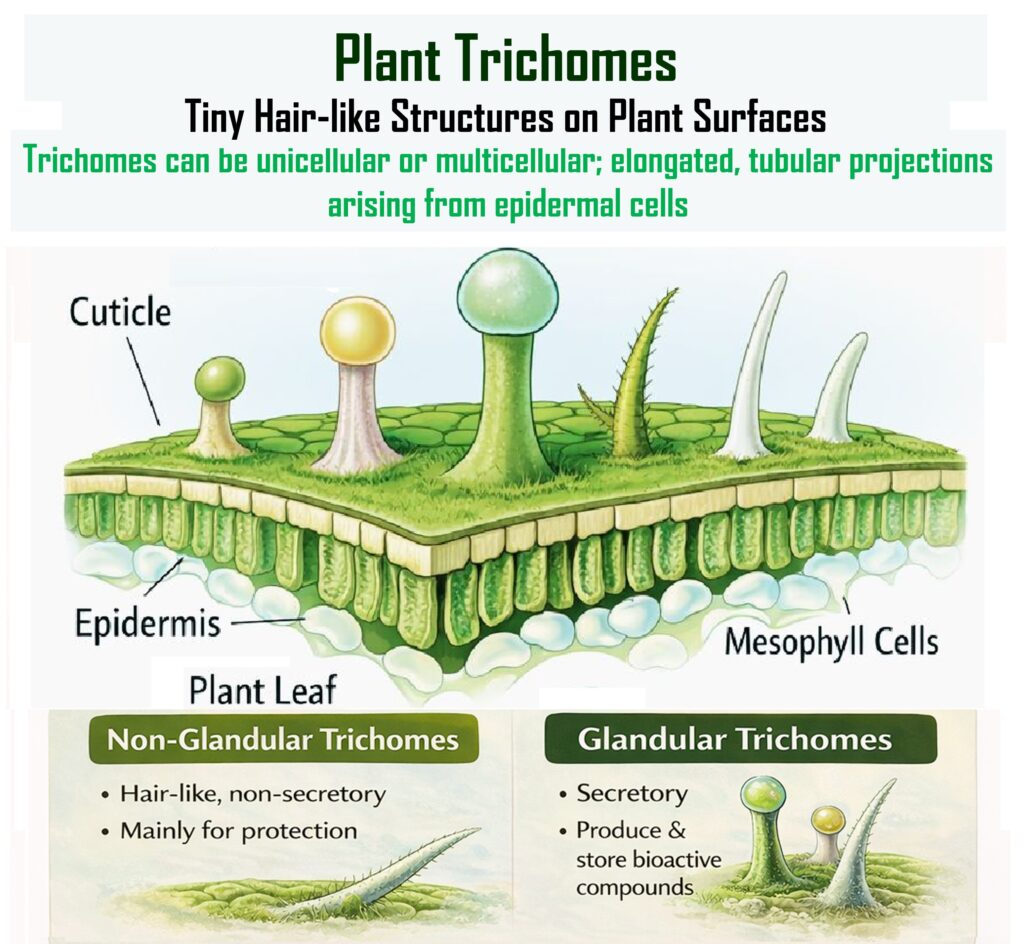
Trichomes are elongated, tubular structures emerging from epidermal cells, either unicellular or multicellular, found on leaves, stems, flowers, and fruits.
They occur in diverse forms across plant species and are broadly classified into non-glandular (hair-like, non-secretory) and glandular (secretory) types.
Their structure, density, and function vary widely across species, organs, and developmental stages. They often serve protective or secretory roles.
Plant trichomes, Epidermal structures, Microscopic plant structures, Epidermal outgrowths, protective structures.
References
Tanney, C.A.S., R. Backer, A. Geitmann, D.L. Smith. 2021. Cannabis Glandular Trichomes: A Cellular Metabolite Factory. Frontiers in Plant Science 12: 721986.
Brentan Silva, D., A.-K. Aschenbrenner, N.P. Lopes, O. Spring. 2017. Direct Analyses of Secondary Metabolites by Mass Spectrometry Imaging (MSI) from Sunflower (Helianthus annuus L.) Trichomes. Molecules 22: 774.