
Watershed Dynamics: Structure, Functions, and Ecological Importance
Watersheds are key components of the Earth’s hydrological system, regulating the movement, storage, and quality of water while sustaining ecological integrity, agricultural productivity, and human livelihoods. Commonly, watersheds are called drainage basins or catchments; they encompass all land areas that channel precipitation toward common water bodies, including rivers or lakes (and even wetlands or oceans).
In regions prone to climatic variability and increasing environmental stresses, watershed management has become key to sustainable development. In Pakistan, where landscapes range from the glaciated Himalayas and the Indus Basin to arid and semi-arid plains, watershed dynamics directly influence groundwater recharge, irrigation potential, soil conservation, biodiversity, and flood resilience. Understanding watershed processes is therefore essential for environmental planning, climate adaptation, and sustainable agriculture.
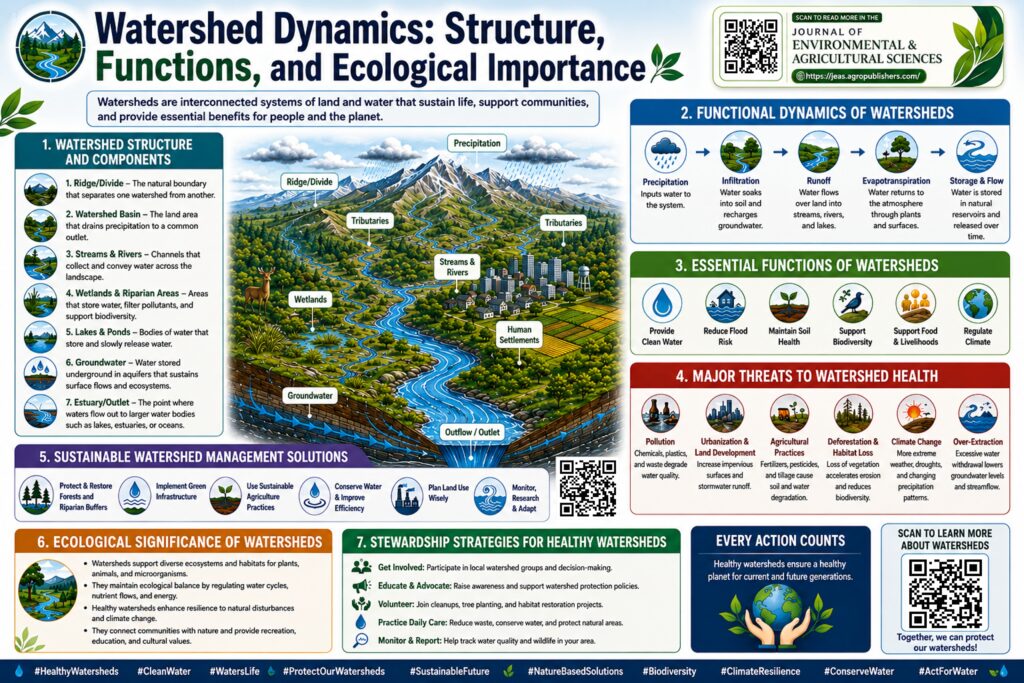
What is the General Structure and Components of a watershed?
Related Topics
What is the General Structure and Components of a watershed?
Watershed Dynamics: Structure, Functions, and Ecological Importance
Major Threats to Watershed Health
How does a watershed function?
What are the core functions of a watershed?
What are threats to watersheds?
What are the potential solutions to watershed-related issues?
What is the ecological Importance of watersheds?
Stewardship for healthy watersheds
#WatershedManagement #Hydrology #WaterResources #EnvironmentalScience #EcosystemServices #SustainableAgriculture #ClimateChangeAdaptation #SoilWaterInteractions #IntegratedWaterManagement #LandscapeEcology #WaterSecurity #FloodManagement #BiodiversityConservation #Agroecology